Publications et outils

Nous avons organisé la bibliothèque de nos publications et de nos outils, toujours plus nombreux, dans le but de mieux servir le mouvement des travailleur·se·s du sexe, les bailleurs de fonds et les alliés. Nous avons mis en évidence les sujets clés qui recoupent notre travail, en particulier l’allocation participative des financements, la recherche de bailleurs de fonds et d’autres documents réalisés par les réseaux régionaux, les bailleurs de fonds qui soutiennent les travailleur·se·s du sexe et d’autres organisations qui soutiennent les droits des travailleur·se·s du sexe.

Il existe près de 200 publications et outils répertoriés, nous nous sommes appuyés sur des outils de traduction en ligne pour les rendre plus accessibles dans d’autres langues. Veuillez excuser toute erreur.


This document has been developed for sex workers’ rights activists as a template on how to approach some of the most commonly asked questions by media representatives. It can be intimidating for activists with no experience to work with journalists and you might not feel confident enough to engage with them. But sex workers have the real-life knowledge from their experiences, and this makes them an expert on sex work. Still, it is important that sex workers feel able to communicate their thoughts and arguments in a way that is useful and safe for themselves, for their community and sex workers’ rights. We hope that this guide will give some directions so that sex workers can become more confident. This document is not meant to tell sex workers what they should think or say but merely to make them aware of the common topic of interests shown by media when talking about sex work and of the rhetoric commonly used by sex workers? rights movement to tackle these questions.

Afficher
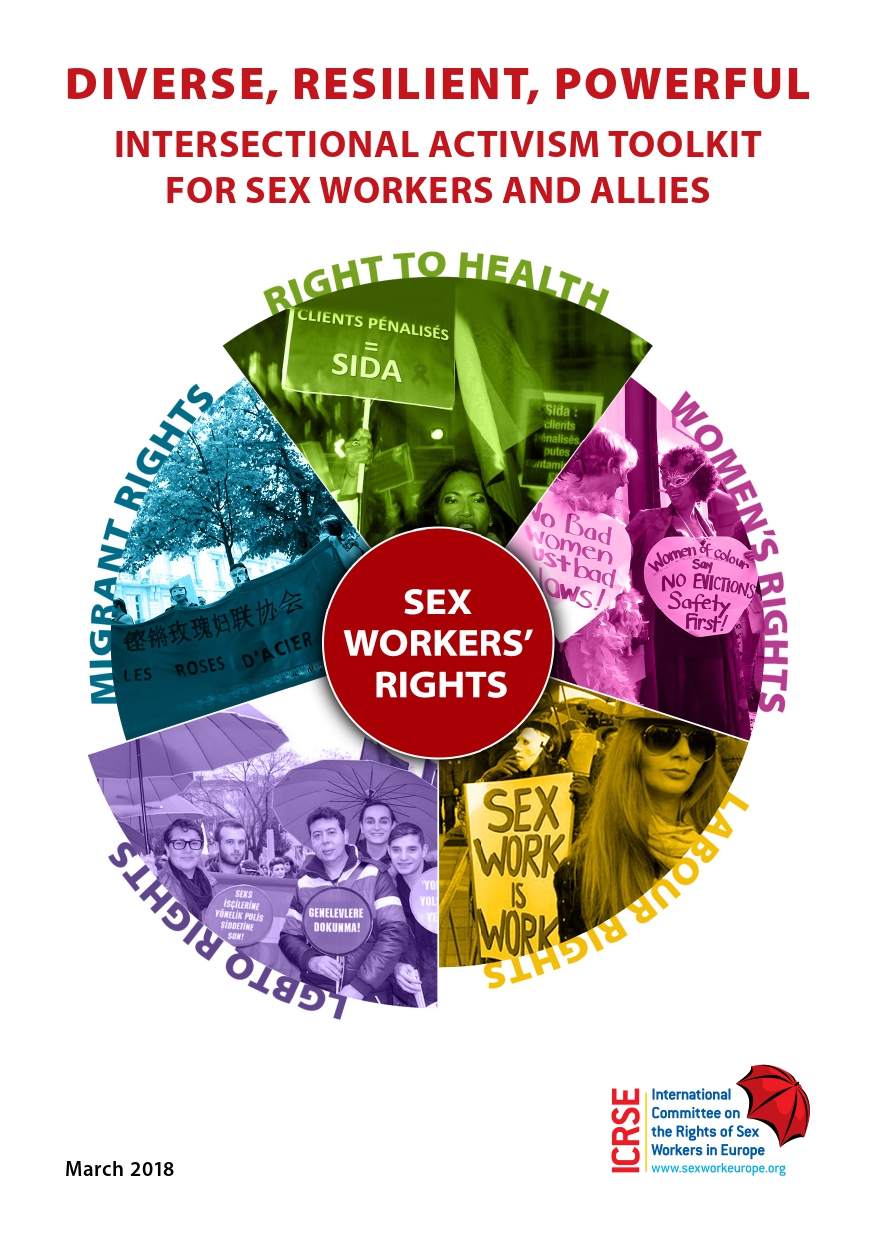
Cette boîte à outils résume chaque document de briefing d’intersection développé au cours des trois dernières années sur les droits des travailleurs du sexe en tant que droits des migrants, droits des femmes, droits LGBTQ, droits du travail et droit à des questions de santé. Il comprend en outre une infographie sur les cadres juridiques et recommandations juridiques aux travailleurs du sexe et Alliés sur la façon de construire des mouvements de justice sociale intersectionnels, y compris tous les travailleuses du sexe.

Afficher

This joint briefing paper by NSWP and INPUD highlights the specific needs and rights of sex workers who use drugs, as a community that spans two key populations. This document provides an overview of some of the most endemic and substantive ways in which sex workers who use drugs face double criminalisation and associated police harassment, intersectional stigma, compounded marginalisation and social exclusion, heightened interference and harassment from healthcare and other service providers, infantilisation, pathologisation, and an associated undermining of agency, choice, and self-determination. A Community Guide is also available.

Afficher

This joint briefing paper by NSWP and INPUD highlights the specific needs and rights of sex workers who use drugs, as a community that spans two key populations. This document provides an overview of some of the most endemic and substantive ways in which sex workers who use drugs face double criminalisation and associated police harassment, intersectional stigma, compounded marginalisation and social exclusion, heightened interference and harassment from healthcare and other service providers, infantilisation, pathologisation, and an associated undermining of agency, choice, and self-determination. A Community Guide is also available.

Afficher

Globally sex workers experience a number of barriers to comprehensive
sexual and reproductive health (SRH) services, ranging from explicit
exclusion from international financing to discrimination within SRH
services leading to lower access rates.

This paper discusses the obstacles sex workers face when accessing
SRH services, and examines the quality of services available to them. It
also provides practical examples and recommendations for improving the
accessibility and acceptability of SRH services for sex workers.

A Community Guide is also available.

Afficher

This Briefing Paper documents the stigma and discrimination experienced by LGBT sex workers and highlights differences in their experiences when compared with other members of their respective communities. It also includes recommendations for addressing the double stigma and discrimination experienced by those at the intersection of the sex work and LGBT communities.

Afficher

In the first quarter of 2019, the Network of Women Sex Workers of Latin America and the Caribbean (RedTraSex) proposed to the Consortium for Parliamentary Dialogue and Equity AC (Consortium), to join efforts to carry out a pilot research that would provide valid and quantitative information for the debate that would take place at the XIV Regional Conference on Women in Latin America and the Caribbean at ECLAC, which has as its central theme the economic empowerment of women, thus the present exploration was born. This report presents the results of the quantitative study and the collection of secondary data on the contribution of women sex workers to the economies of the countries, based on the income and expenses they obtain from their work, which represent a flow in the regional economy.

Afficher

Videos in a series from NSWP called Global Fund Basics.
Included are videos on:
The Board, Constituencies/Delegations, and Committees- you’ll hear about the history of the Global Fund, how it’s structured, how it works, the three civil society delegations and the three standing committees.
Country Coordinating Mechanisms (CCM) – The CCM is responsible for identifying the work that needs to be done in HIV, Tuberculosis and Malaria, and submitting technical proposals to the Global Fund, identifying the Principle Recipient and overseeing the implementation of grants.
Catalytic Investments – Catalytic Investments are a portion of funding for the Global Fund supported programmes, activities and strategic investments that are not fully covered through country allocations.

The videos are in English and is also available with Spanish, French, and Russian subtitles.

Afficher

Ce guide futé présente certaines des tendances actuelles en matière d’utilisation des TIC, examine les bonnes et les mauvaises pratiques, ainsi que les menaces et les difficultés qui pèsent sur la sécurité, la vie privée et le bien-être des travailleurSEs du sexe. Il attire l’attention sur la nécessité de développer des TIC qui répondent aux normes de sécurité les plus strictes, qui sont dirigées et contrôlées par la communauté, qui protègent la santé et les autres droits humains des travailleurSEs du sexe, et qui ne remplacent pas les services essentiels en face à face qui leur sont proposés, ni ne compromettent l’autonomisation de la communauté au niveau local. Ce guide futé s’appuie sur l’expertise de travailleurSEs du sexe et d’informateurs clés et se termine par des recommandations à l’intention des différentes parties prenantes.

Afficher

The European Sex Workers’ Rights Alliance is proud to launch its latest Impact Report which highlights our key successes between 2010-2020. This report aims to educate members, partners, funders and other stakeholders on the impact of ESWA work over the last 10 years in areas such as advocacy, policy, capacity building and sub granting to its members. In these turbulent political times, fighting for sex workers’ rights and promoting a human rights and public health-based approach to sex work can be very challenging. We hope this Impact Report highlights some of the important changes ESWA and its members have achieved in our region.

Afficher

In 2013, The WHO together with UNFPA, UNAIDS, UNDP the Global Network of Sex Work Projects (NSWP) and the World Bank published ‘Implementing Comprehensive HIV/STI Programmes with Sex Workers: Practical Approaches from Collaborative Interventions’ (or the SWIT as the document has become known). The SWIT reaffirms that the health of sex workers doesn’t happen in a vacuum, and that countries should work towards the decriminalisation of sex work, and the empowerment and self-determination of sex working communities, as a fundamental part of the fight against HIV.

Afficher

Partout dans le monde, les travailleurSEs du sexe s’organisent pour améliorer la protection de leurs droits, combattre l’exploitation et la violence, l’accès aux soins de santé appropriés et respectueux et construire des mouvements pour un changement durable. Le Guide Futé des TravailleurSEs du Sexe pour des Financements Durables contient des informations pratiques sur les stratégies de financement pour les organisations de travailleurSEs du sexe. Il discute le développement d’une stratégie de financement, demande de subventions, la gestion financière et la collecte de fonds communautaires.

Afficher

« The lives of LGBTQ sex workers in Central Europe, Eastern Europe and Central Asia are impacted by many hardships, including precarious living conditions, various forms and levels of criminalisation and discrimination as well as violence and human rights violations. […] This briefing paper developed by SWAN aims to fill the gap in knowledge about LGBTQ sex workers in Central Europe, Eastern Europe and Central Asia. » Available in English and Russian.

Afficher